

Anthony O’Toole Shares Lessons from the 2026 Chef's Manifesto Action Hub at OmVed Gardens, London
What Story Does Your Food Tell?


Anthony O’Toole Shares Lessons from the 2026 Chef's Manifesto Action Hub at OmVed Gardens, London
 Earlier this summer, I swapped my Fat Tomato garden in North Wexford for another remarkable garden – OmVed Gardens in North London. As an active member of the Chef's Manifesto, I was delighted to return to OmVed for my fourth Action Hub, the annual gathering led by Paul Newnham and his team through the United Nations SDG2 Advocacy Hub. Bringing together chefs, growers, farmers, educators and food advocates from around the world, the Chef's Manifesto asks a simple but important question: what role can chefs play in building healthier, fairer and more resilient food systems?
This year's gathering explored one timely theme: resilience.
Hidden behind an ordinary residential street, OmVed Gardens is a place where food, biodiversity, art and education come together. Its heritage seed-saving network protects open-pollinated varieties and the knowledge that comes with them – a reminder that food is about far more than what's on the plate. One phrase echoed throughout the day: "If you eat, you're in."
Building better food systems isn't solely the responsibility of chefs, farmers or policymakers. Every one of us shapes them through the food we choose to grow, buy, cook and serve.

Joining me from Ireland were Ali Honour and Conor Spacey, two leading voices in food systems thinking. Through FoodSpace, Conor is reshaping workplace catering by connecting kitchens with better producers and more sustainable sourcing, while Ali champions vegetables, climate-conscious cooking and beans through her consultancy and writing.
One presentation stayed with me. Conor spoke about developing a cookery school in The Gambia, West Africa. Rather than beginning with kitchens or recipes, the project started with clean water. Before a single wall was designed, the team first sought to understand the landscape, its water systems and the ecology that supports food production. It reinforced something I've believed for a long time: Nourishing food begins long before the kitchen.
Another conversation over lunch stayed with me too. We found ourselves asking a question that comes up time and again when discussing food security. What's the solution?
Perhaps that's the wrong question. The answer, of course, is that there isn't one. Resilient food systems are built through thousands of people, ideas and local solutions working together.
 Perhaps one of our greatest mistakes has been believing that progress always means moving forwards. Sometimes the answers are already behind us. Thousands of heritage varieties have evolved over generations to thrive in different soils, climates and conditions. Diversity isn't a weakness in our food system. It's one of its greatest strengths. That idea mirrors the work I do through AOT. Across Ireland, I work with artisan producers, chefs, hotels, destinations and public bodies to uncover the stories that already exist, then help build the connections that allow those stories to flourish. Too often, extraordinary producers remain disconnected from the kitchens, hotels and visitor experiences that could celebrate their work, while destinations speak passionately about authenticity and local identity yet their food and drink fail to express either.
I don't believe Ireland has a shortage of great farmers and producers. I believe we have a shortage of connections.
 Increasingly, I believe my role is to help the right people find one another. Because when growers, farmers, producers, chefs, hospitality businesses and destinations work together, every community becomes stronger.
Food isn't the starting point of a place story. It's the expression of it. The ingredients may be local, but unless your guests understand why they matter, you've only told half the story. Today's visitors don't simply travel to eat well. They travel to understand where they are. They want to meet producers and experience flavours that could only exist in that landscape. Food has become one of the most powerful ways to understand a place, connecting people with its landscape, culture and the hands that produce it.
My Fat Tomato garden has become my living laboratory for these ideas. Growing over 500 heritage varieties has taught me something we've largely forgotten: a tomato isn't a single ingredient. There are more than 10,000 recognised varieties around the world, each with its own story. Yet we've reduced all of that extraordinary diversity to a handful of commercial varieties bred primarily for yield, uniformity and shelf life.
Healthy food isn't complicated. It begins with healthy soil. Clean water. Diverse seed. Growers working with nature. And producers and chefs willing to celebrate difference rather than uniformity.

Perhaps we've spent too long chasing efficiency and margins instead of celebrating the people already producing food exceptionally well. Our industry has become very good at talking about sustainability. But awareness alone doesn't restore biodiversity. Talking about local food doesn't automatically strengthen local food economies. Action does.
So here's my challenge.
If you work in food production and hospitality:
• Plant something edible. Replace artificial plants with herbs, fruit trees or edible flowers that guests can smell, taste and remember.
• Build a relationship with one grower, farmer or artisan producer you've never worked with before.
• Put one forgotten ingredient on your menu – perhaps a perennial green, a heritage grain, beans, hogget, goat or venison.
• Tell one story that could only be told where you are.
And if you're someone who shops for food every week, support the people quietly shaping your local food culture. Buy eggs from the honesty shop down the road. Choose a farmhouse cheese made in your county. Visit the farm shop instead of the supermarket when you can. Eat vegetables in season. Every purchase is a vote for the kind of food system you want to see.
Because resilience won't be built by another conference. Or another report. It will be built through thousands of small actions. One seed planted. One producer supported. One forgotten variety grown again. One story shared. One plate of seasonal vegetables. That's how resilient food systems are built.
OmVed didn't change what I believe. It reinforced it. We don't need one solution. We need thousands of people connecting the solutions that already exist.
 Anthony O'Toole works with food, hospitality, tourism and cultural projects across Ireland, helping shape strategy, experiences, destinations and place-based development. https://www.anthonyotoole.com/ https://www.fattomato.ie/
By same author
-
What Story Does Your Food Tell?
Food Feature - Slow Food Weekend of Flavour an ...
Slow Food Weekend of Flavour and Stories – AnthonyO’Toole’s Reflections from a magical couple of days in Comber, Co DownA LONG TIME COMING - ANTHONY O'TOOLE'S HORTICU ...
Perched on the picturesque Carrig Rua Hill in North Wexford behind his parents' house, Anthony’s tiny garden is now home to over 500 varieti ...SPECIAL EVENTS AT THE WORLD-RENOWNED WOODCOCK ...
Busy-bee chef ANTHONY O’TOOLE explains how he’s getting together with the legendary SALLY BARNES to host a Producer x Chef event serie ...Diary of a Failte Ireland Food Champion
This month Failte Ireland Food Champion Anthony O'Toole welcomes the recently released Fáilte Ireland Food and Drink Strategy for 2018-2023.Diary of a Failte Ireland Food Champion
Last June Anthony O'Toole was one of a group appointed as the new Fáilte Ireland Food Champions. So, one year later, what have they been u ...Diary of a Failte Ireland Food Champion
In the latest of his monthly columns, Failte Ireland Food Champion Anthony O'Toole welcomes the new food festival seasonDiary of a Failte Ireland Food Champion
April is one of my favourite months of the year. Not just because it is my birth month, but because the days are getting longer, the spring air is ...Diary of a Failte Ireland Food Champion
It’s February already. We’re six weeks into 2017 and already we’ve seen some promising developments around Ireland in terms of f ...Diary of a Failte Ireland Food Champion
Failte Ireland Food Champion Anthony O'Toole tells us about a memorable benchmarking trip to Denmark, that will help to “put our little gree ...Articles
-
2026 Georgina Campbell Irish Food & Hospitality ...
Winners of the Georgina Campbell 2026 Irish Food & Hospitality Awards announcedCookery & Artisan Foods - Inspired by BLOOM
The June bank holiday weekend had plenty going for it this year – not least the sunshine – and Bord Bia Bloom celebrated its 20th year ...Apps and Books
-
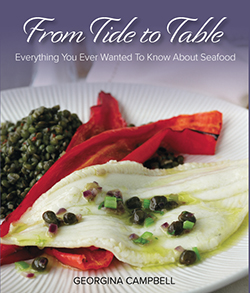
From Tide to Table by Georgina Campbell
Paperback edition of From Tide to Table - Everything You Ever Wanted To Know About Buying, Preparing & Cooking Fish and Seafood by Georgina Campbell
There are currently no comments
Leave a comment
Not a member? Register for your free membership now!
Or leave a comment by logging in with: